The Butterfly Valley Walk: Trail, Bridges, Steps And The Panagia Kalopetra Monastery
The Butterfly Valley walk is a shaded 1.3 km climb along the Pelekanos river to the Kalopetra monastery. Here is what is verified about the trail, the steps, the bridges and the terrain, and how to decide whether to walk it alone or with a guide.
Short answer
The Butterfly Valley walk follows the Pelekanos river for 1.3 km to the Kalopetra monastery at about 370 m, crossing wooden bridges and cobbled paths past springs, ponds and waterfalls. The operator calls the paths steep and natural, with no step count or time published. Adults pay EUR 3 to 6, by season; children under 12 go free.
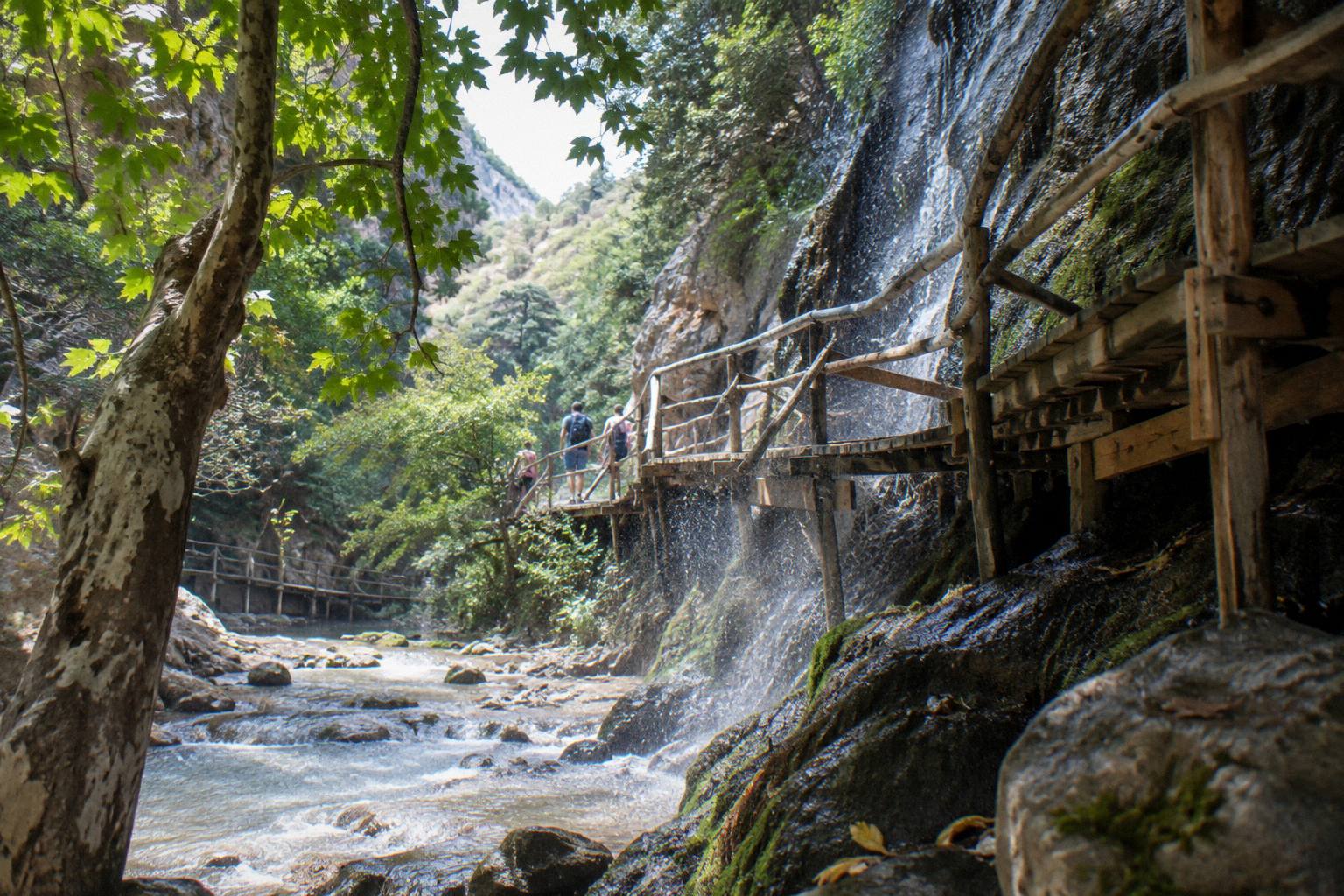
The trail inside Butterfly Valley on Rhodes runs 1.3 km from the entrance area up to the Kalopetra monastery, and every metre of it follows water. The Pelekanos river feeds springs, ponds and small waterfalls down the gorge, and the path crosses it on wooden bridges stitched between cobbled sections and natural rock, all of it under the shade of the Oriental Sweetgum trees that make this one of the only biotopes in Europe where they grow. This is the walk the whole site is built around, and it is worth understanding before you book anything through Butterfly Valley Rhodes, because the terrain decides who enjoys the valley and who merely endures it.
What follows is only what the valley's own operator, DERMAE, publishes about the trail, cross-checked against the tour listings on this site. Where a number is not verified, this guide says so instead of guessing.
How Long Is The Butterfly Valley Walk In Rhodes?
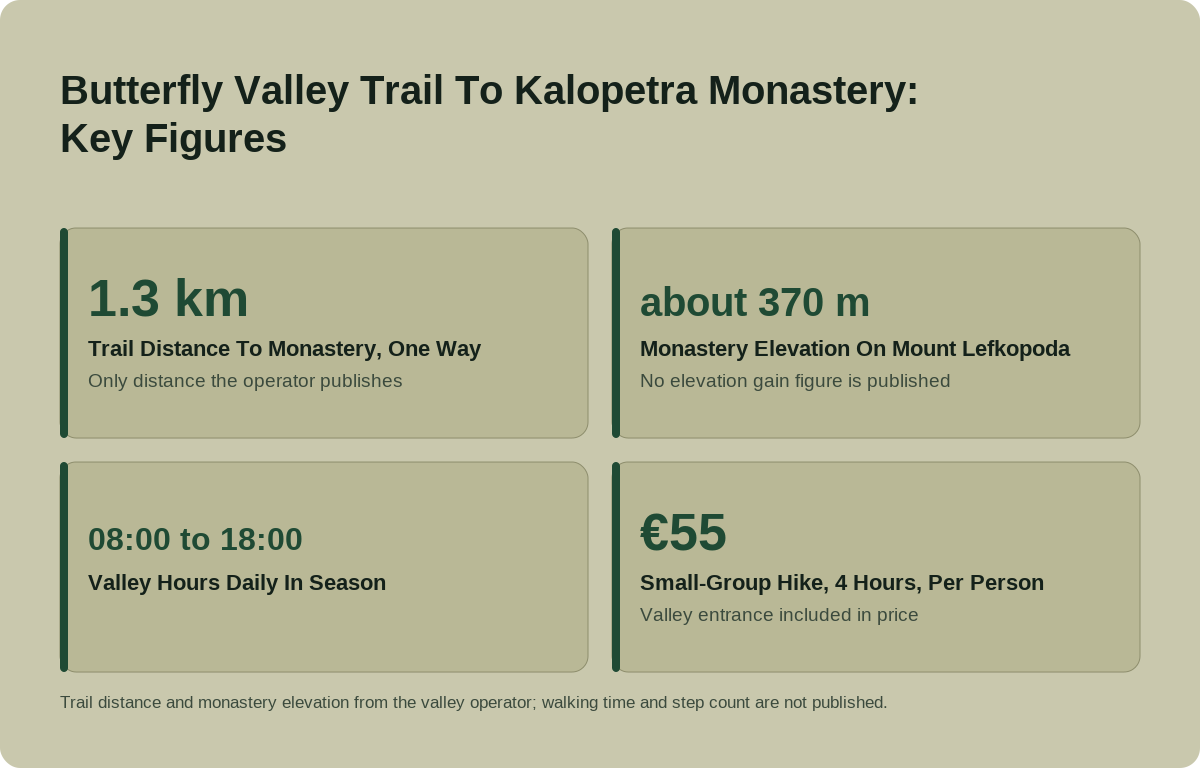
The trail to the Kalopetra monastery is 1.3 km one way, but no walking time, step count or difficulty grade has been published by the valley's operator, so any minute figure you read elsewhere is an estimate rather than a fact. What is verified is the shape of the walk: a shaded climb along the Pelekanos river, over wooden bridges and cobblestone paths, with springs, ponds and waterfalls along the way, ending at the monastery at about 370 m.
That 1.3 km figure comes from the valley's own monastery page on the operator's Kalopetra page, and it is the only distance the operator commits to. The same page describes the route as running along the river, which is why the walk feels cooler than the exposed roads above the valley even in the height of the Greek summer. The gorge holds shade for most of the day, and the water keeps the air moving.
The absence of a published walking time matters more than it sounds. A 1.3 km path on flat pavement is a twenty minute stroll; the same distance on steep natural paths with stepped sections and bridge crossings can easily run two or three times longer, especially in the season when the trail is busy and the going is slow. The valley's own visitor information page lists the practical details like hours and tickets, but not a duration, so the honest answer is that your own pace sets the clock.
If you want a full breakdown of where the valley sits on the island and how to reach the trailhead, the guide on getting to Butterfly Valley from Rhodes Town covers the transport side. For the trail itself, the table below sets out what is and is not verified.
| Trail detail | What the operator publishes | What this means for you |
|---|---|---|
| Distance to Kalopetra monastery | 1.3 km, one way | Double it for the return, or plan the descent separately |
| Walking time | Not published | Any figure you see is an estimate |
| Step count | Not published | Expect stepped sections, no number exists |
| Difficulty grade | Not published | "Steep natural paths" is the official wording |
| Accessibility | Not accessible for people with disabilities | The operator's own statement |
| Terrain | Cobblestone paths, wooden bridges, natural rock | Grippy footwear matters |
What Is The Trail To Kalopetra Monastery Like?
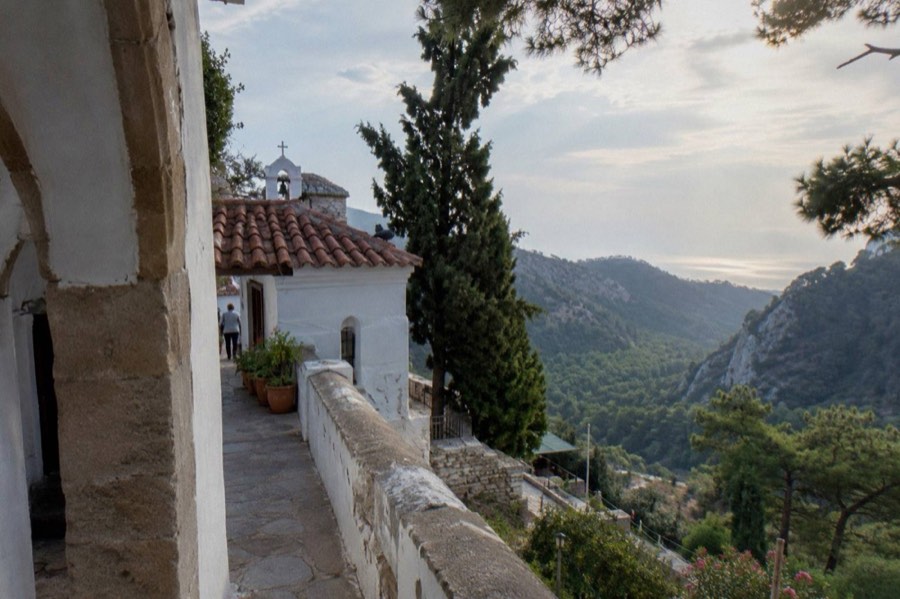
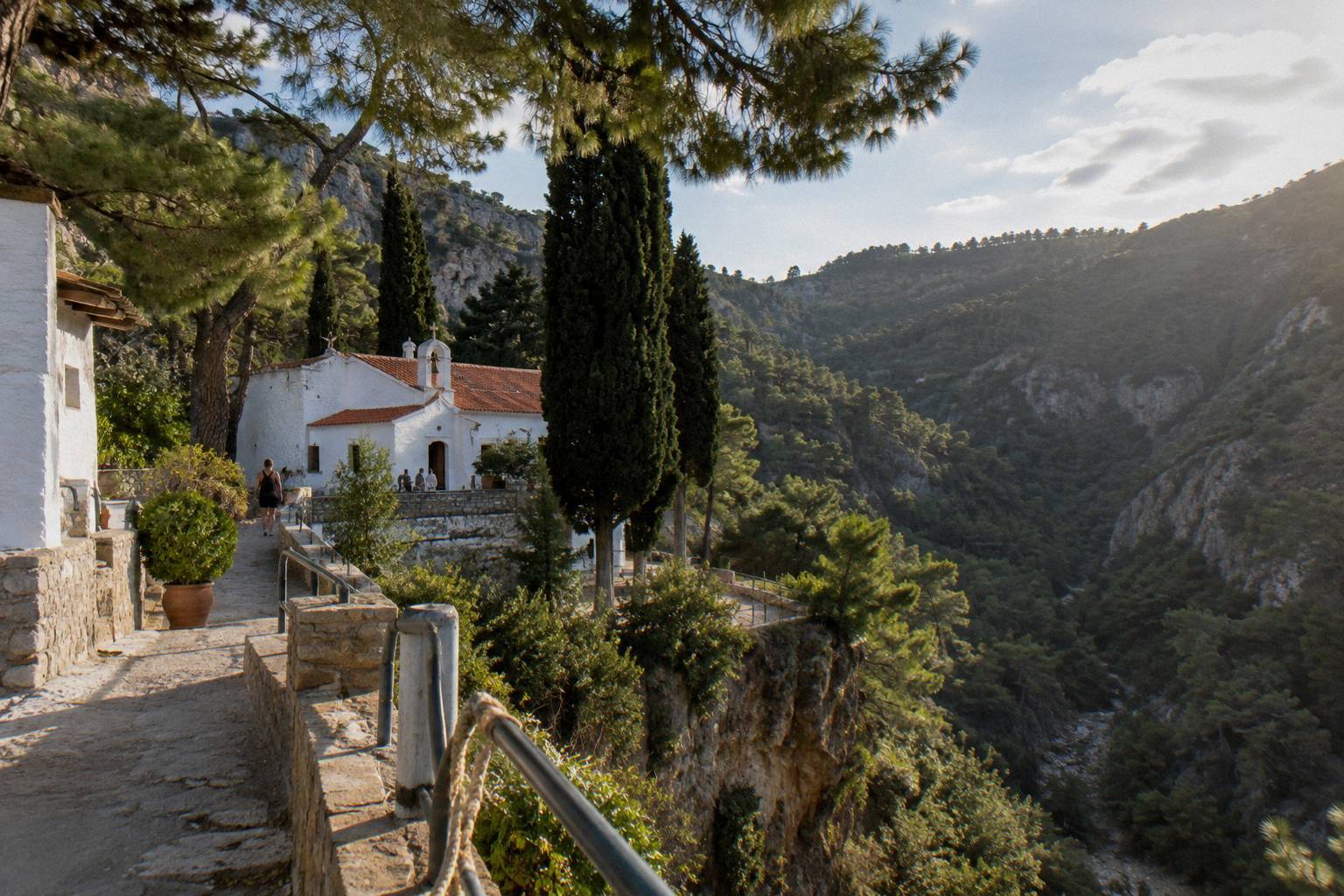
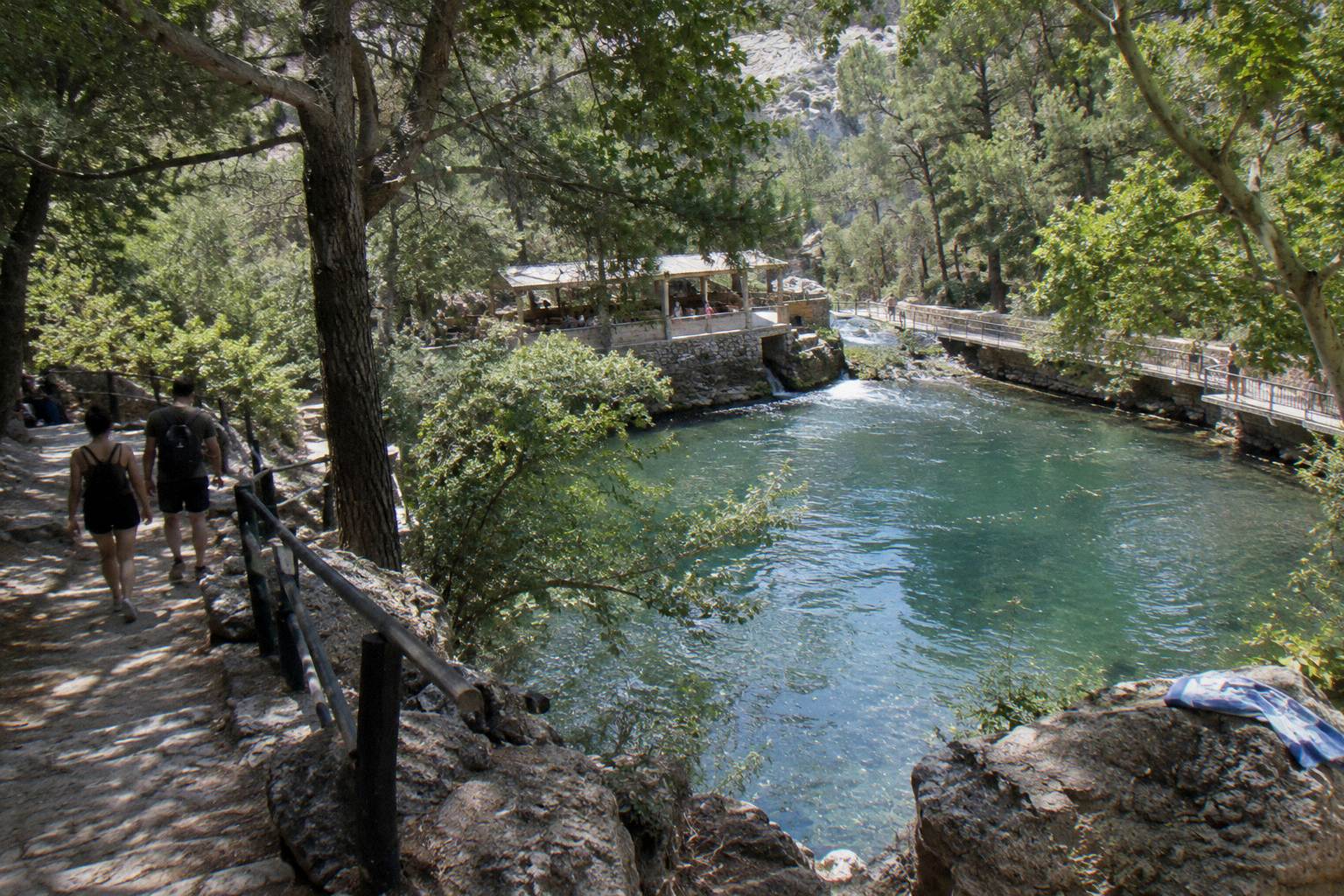
The 1.3 km trail follows the Pelekanos river uphill through a shaded gorge, crossing the water on wooden bridges and climbing over cobblestone paths past springs, ponds and waterfalls before reaching the Kalopetra monastery at about 370 m on a slope of Mount Lefkopoda. The monastery is dedicated to the Assumption of the Virgin Mary, and its name means "good stone".
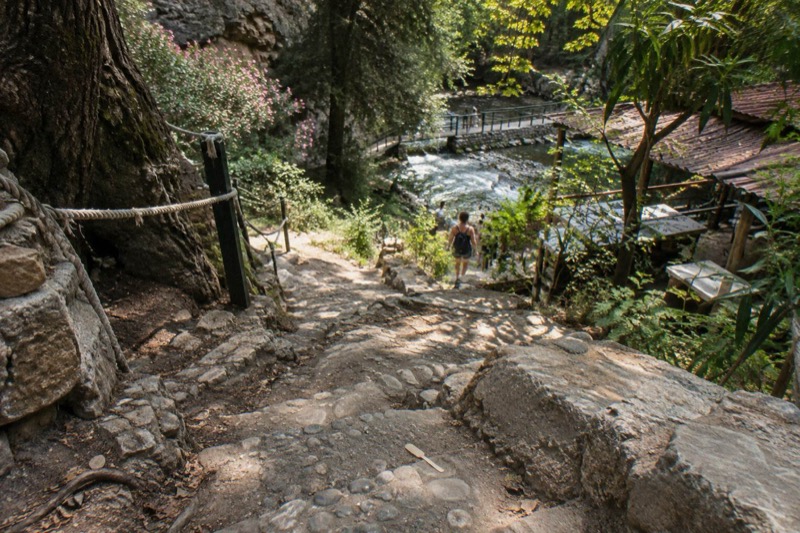
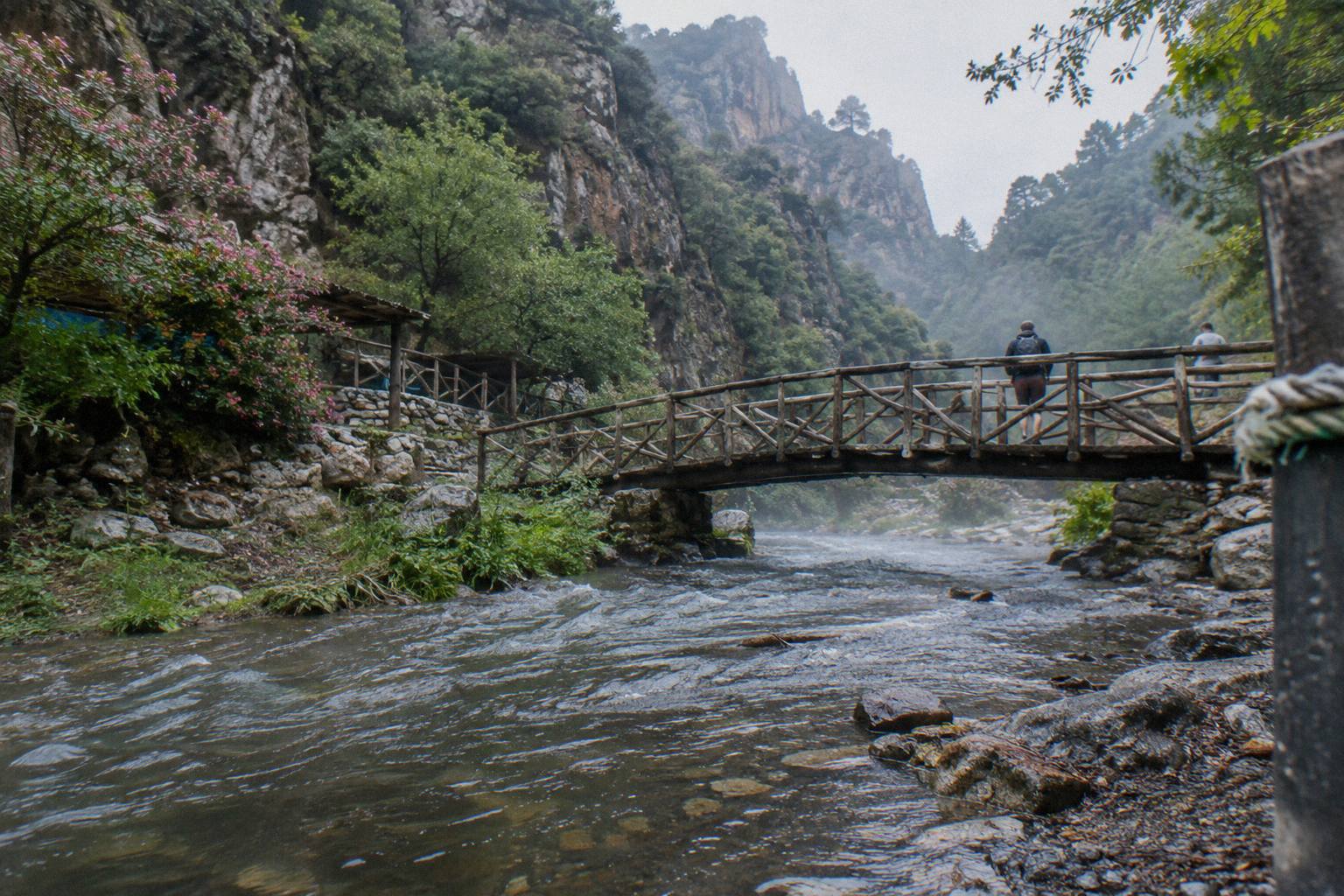
The walk has a rhythm that becomes obvious within the first few hundred metres. The path hugs the river, so you are never far from running water, and the wooden bridges appear wherever the gorge narrows and the route has to switch banks. Between the bridges the surface alternates between cobbles laid by hand and sections of bare natural rock, which is why the operator describes the terrain as steep and natural rather than as a promenade. The full description, including the sweetgum trees and the water features, is on the valley's own about page.
The vegetation is part of the experience and not just a backdrop. The Oriental Sweetgum, known locally as "Zitia", is the tree the moths are believed to be drawn to, probably for its resin, and the valley is one of the only places in Europe where it grows in this concentration. That canopy is what keeps the trail shaded, and it is also why the valley feels like a different island from the dry hillsides you drive through to reach it.
At the top of the climb sits the monastery, at about 370 m on the slopes of Mount Lefkopoda, with a Museum of Natural History mentioned by the operator on the same page as part of the hike. The view back down the gorge is the reward, and most people treat the monastery terrace as the turn-around point before the descent.
If you would rather not drive yourself to the trailhead, three options cover the spread from a guided walk to a simple bus ride:
The differences between those three come down to how much of the day is the valley itself. The hiking option, the Small-Group Hike, 4 Hours by Hiking rhodes, devotes a 4 hour whole-tour to the walk and includes the valley entrance in its price, from €55 per person; it has a single review so far, so there is no rating to report yet. The coach option stretches the day to 7 hours by adding Seven Springs, and the budget bus simply gets you there and back for the smallest outlay on this site.
Is The Butterfly Valley Walk Hard?
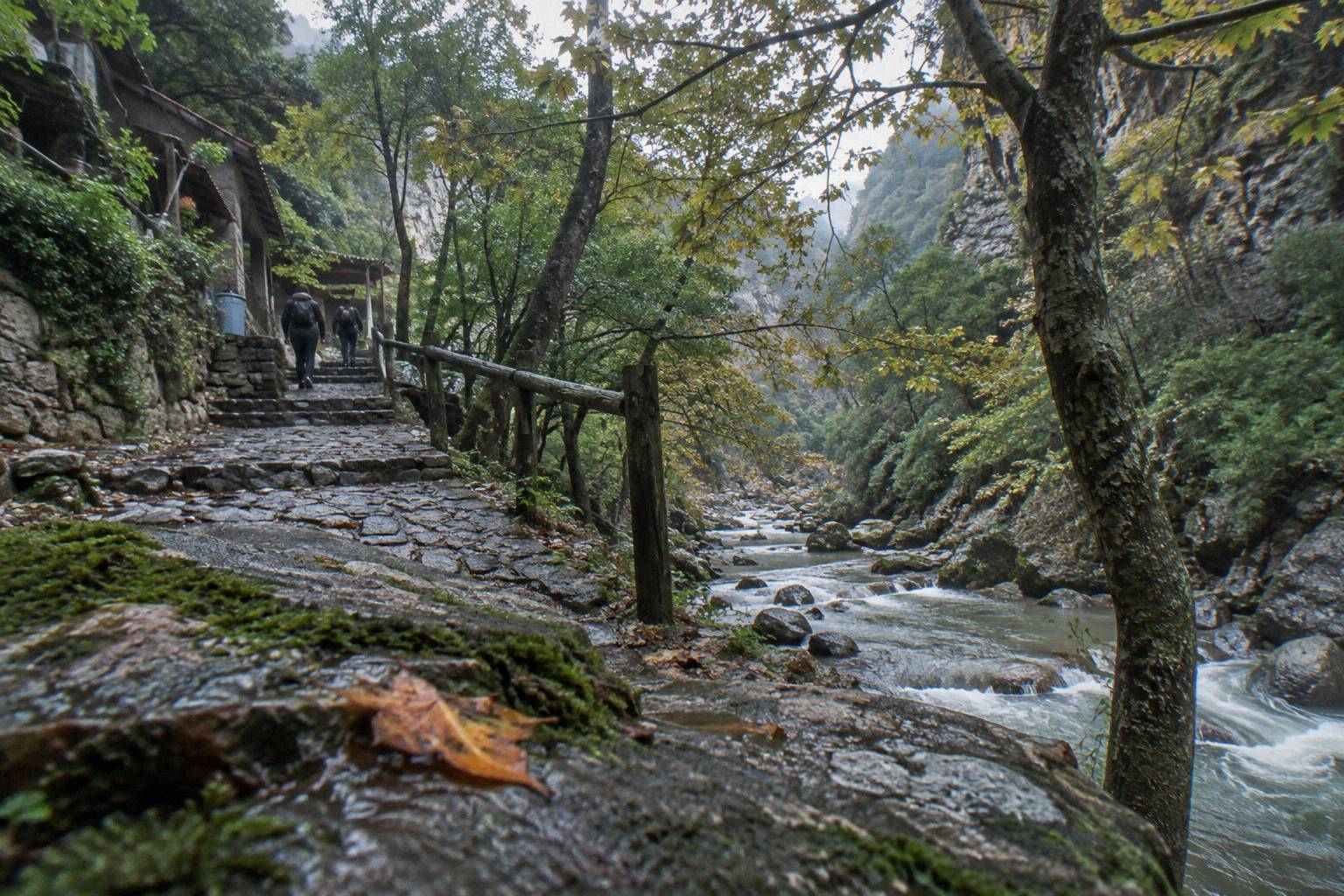
Yes, the Butterfly Valley walk is hard. The valley's operator describes the paths as steep and natural and states plainly that the site is not accessible for people with disabilities, so treat the walk as a genuine uphill hike rather than a garden stroll, and expect real effort underfoot the whole way. There is no published difficulty grade, but the combination of stepped sections, cobbled surfaces and natural rock underfoot asks for decent balance and shoes with grip.
The steepness is the honest headline. The trail climbs through a gorge to a monastery at about 370 m, and while the operator publishes no elevation gain figure, the geometry of a 1.3 km path ending that high above the entrance tells you the gradient is real. Children who walk confidently tend to manage it, but the surface is uneven enough that pushchairs are not a realistic option; the question of whether Butterfly Valley suits kids and pushchairs is worth reading before you commit as a family.
The accessibility statement is not boilerplate. The operator puts it on the home page alongside the opening hours, which suggests it reflects a real constraint of the terrain rather than a cautious legal line. Steep natural paths with steps and bridges cannot be made step-free, and the valley has chosen to keep the trail wild rather than engineer it.
Weather adds a second variable. The shade keeps the gorge cooler than the coast, but the season runs from April into October, and the descent after rain can be slick on the cobbles and rock. The valley asks only one thing of walkers beyond ordinary care, and that is silence, a rule covered in its own section below.
If the description of the terrain makes you want someone else handling the day, the guided options below keep the walk itself in your legs while taking the logistics off your plate.
What Is The Keep-Quiet Rule On The Trail?
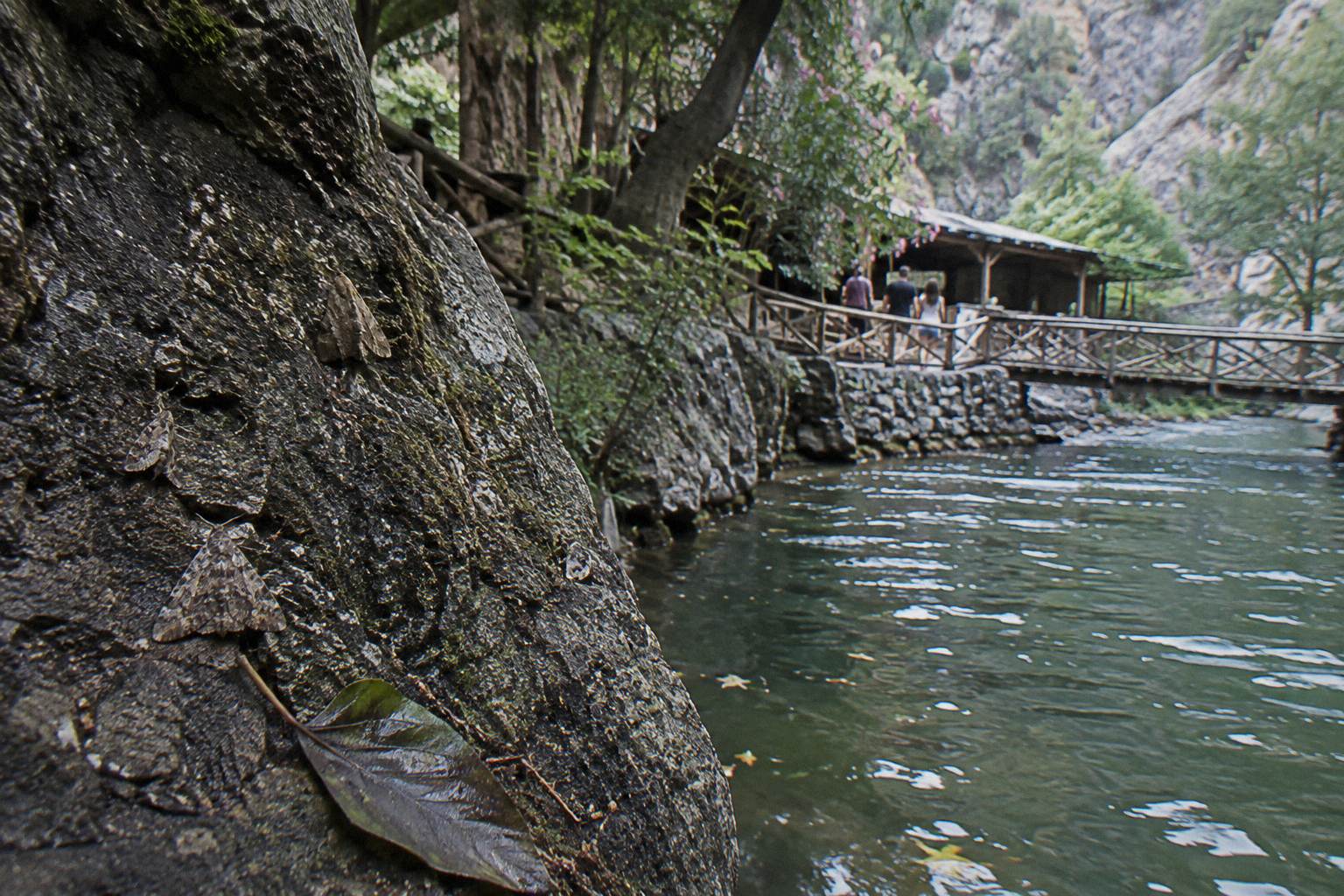
According to the valley's own administration page, the keep-quiet rule is the only rule on the trail: visitors must stay silent so they do not disturb the moths. These moths rest on trunks, leaves and rocks by the water during the day, and they fly only when disturbed, so keeping quiet protects them. No other trail rules, such as flash, dog or clapping bans, appear on the operator's official site, so the quiet rule is the one to pass on to your group.
The reason for the rule is biological. The insects in the valley are Jersey tiger moths, Panaxia quadripunctaria, not butterflies, and they are nocturnal. Through the day they rest in the shade along the water, which is exactly where the trail runs, and the operator's species page describes what happens when they wake: a cloud of red and yellow wings rising off the undergrowth. Spectacular for the walker, exhausting for the moth.
Noise is what wakes them. A loud group on the trail puts the day-roosting moths into the air repeatedly, burning the energy they need for the night, which is why the operator frames silence as the site's single rule rather than a suggestion. In practice this shapes the walk: it is a quiet, single-file kind of trail, and families find that children respond well to the challenge of "who can be quietest".
The quiet rule is also the argument against treating the trail as a photo studio. The moths are camouflaged at rest and easiest to see as still shapes on the shaded rocks, which rewards the patient walker over the hurried one. More on the species, including why the name "butterfly" stuck to a moth, is in the guide to Petaloudes moths, not butterflies.
What Should You Wear And Carry For The Walk?
Grippy closed shoes are the one piece of kit the trail genuinely demands, given cobbles, wooden bridges and natural rock underfoot, and beyond that the shade means you need less sun protection than on the rest of Rhodes but more water than you expect on a steep climb. The valley's hours, 08:00 to 18:00 daily in season, let you start early and walk the gorge before the day heats up.
Footwear first. The surfaces alternate between hand-laid cobbles, wooden bridge decking and bare rock, all of it potentially damp from the river and the spray off the waterfalls. Trainers with a real tread cope fine; smooth-soled sandals and flip-flops do not. The steep stepped sections punish thin soles on the descent in particular, when your toes take the load.
Clothing is simpler than for the rest of the island. The sweetgum canopy keeps the gorge shaded for most of the walk, so the fierce Rhodes sun is mostly a concern at the entrance and around the monastery terrace at the top rather than on the trail itself. A hat and a light layer for the exposed sections cover it. The fuller packing breakdown lives in the post on what to wear to Butterfly Valley.
Water and timing are worth pairing together. There is no verified information about refreshment points on the trail itself, so carry what you need for the climb and the return. Starting near the 08:00 opening gets you the coolest hours and the quietest path, and the season details, including the opening date and the ticket bands, are covered in the guide to Petaloudes opening hours and ticket prices.
| Item | Why the trail needs it | Priority |
|---|---|---|
| Grippy closed shoes | Cobbles, bridges and damp rock | Essential |
| Water | Steep 1.3 km climb each way, no verified refill points | Essential |
| Hat and light cover | Exposed sections at the entrance and monastery terrace | Recommended |
| Phone or camera | Moths at rest on shaded rocks beside the path | Optional |
| Walking pole | Helps on stepped descents if you use one normally | Optional |
What Is The Panagia Kalopetra Monastery?
Kalopetra is a monastery dedicated to the Assumption of the Virgin Mary, sitting at about 370 m on a slope of Mount Lefkopoda at the top of the valley trail, with a name that means "good stone", and it is the destination the 1.3 km walk has been climbing towards since the first bridge. The valley's operator mentions a Museum of Natural History in connection with the hike to the monastery on the same page.
The monastery gives the walk its shape. A trail with a destination is a different thing from a trail that simply peters out, and the monastery terrace, with the gorge falling away below it, is where walkers stop, look back down the valley and decide how long they can afford to linger. The operator's Kalopetra page places the site 8 km south of Theologos and about 23 km from Rhodes city, consistent with the valley's own stated position 26 km from Rhodes Town at Ano Kalamonas in the north of the island.
One caution is worth stating plainly: the founding history of the monastery is contradictory even within the operator's own site, with the home page citing one date and the monastery page another, along with a founder's story. This guide prints neither version rather than pick one, and you should treat any confident founding date you read elsewhere with the same scepticism.
The Museum of Natural History is the second reason to make the climb. The operator lists it as part of the monastery visit, which makes the top of the trail a proper stop rather than a viewing point you pass through. For most walkers the monastery turns the outing from a there-and-back slog into a circuit with a purpose.
If you would like a coach day that pairs this walk with the viewpoints above the valley, the Half-Day Bus, Filerimos Stop by Kariba Travel runs a half day from €25 per person with pickup from northern Rhodes hotels and a stop at Filerimos Hill; the valley entrance is listed as an extra paid at the valley, EUR 3 to 6, by season, and no rating has been read for it.
Do You Need A Guided Hike For The Butterfly Valley Trail?
No, the trail is a single signed route up a gorge and needs no guide to navigate, but a guided hike such as the Small-Group Hike, 4 Hours by Hiking rhodes, from €55 per person with the valley entrance included, removes the transport and timing decisions and suits walkers who want the day organised. That listing carries one review, so there is no rating to weigh; free cancellation applies within 24 hours.
The case for going alone rests on the trail's simplicity. One path, one river, one monastery at the top: there is no route-finding to get wrong, and the quiet rule means you lose nothing by walking it in your own silence. If you have a car or use the local buses, covered in the post on whether there is a bus from Rhodes to Butterfly Valley, the independent walk is the cheapest and most flexible version of the day.
The case for the guided hike is everything around the walk. Getting to Ano Kalamonas, 26 km from Rhodes Town and 10 km from the airport, timing the visit against the 08:00 to 18:00 opening hours, and knowing what you are looking at in the gorge are all handled for you. The Small-Group Hike devotes its full 4 hour duration to the valley experience, and its inclusion of the entrance in the price means one less thing to pay on the day.
You can look at the guided hike's full listing for the details, or check availability if the format already fits.
A middle option is the coach day that walks the same trail with more of the island attached. The Coach Trip, Seven Springs Included by Manos Going runs 7 hours, picks up in Faliraki, Rhodes City, Ixia and Ialysos, and is rated 4.6 across 214 reviews, the most-reviewed tour on this site; it lists the valley entrance as an extra, EUR 3 to 6, by season. The comparison of every format is in the guide to Butterfly Valley tours from Rhodes compared.
Which Budget Options Still Get You Onto The Trail?
The cheapest way onto the trail is the Budget Bus, Half Day by SEBECO LINES, from €15 per person with pickup from Rhodes hotels, and it leaves you to walk the 1.3 km route independently with the entrance paid at the valley, EUR 3 to 6, by season. A slightly richer budget option, the Small-Group Seven Springs Trip by Rhodes-Tours at from €25 per person, pairs the valley with a second stop inside 4 hours 30 minutes.
Budget transport does not change the trail. Whether you arrive on a €15 bus or a private charter, the walk itself is the same shaded climb over the same bridges, which makes the cheap options genuinely good value for confident walkers who only need the lift. The Budget Bus has no rating read for it, and its listing states free cancellation up to 24 hours before departure if your plans might shift.
The Small-Group Seven Springs Trip, from €25 per person with pickup in Rhodes, adds the springs and tunnel of Seven Springs to the same half day, which turns the outing into a two-gorge day for walkers who have legs to spare. Its listing says nothing about the valley entrance either way, so read the fine print on the operator's live listing.
For visitors who want the valley without the bus timetable, the Unguided Valley Visit by Faliraki Excursions collects from Faliraki from €16 per person and adds a stop at the Kalopetra Monastery road's companion sight, with no rating read and no duration published. The trade-off across all three is simple: less money means less hand-holding and fewer inclusions, and the entrance is almost always yours to pay at the gate.
| Option | Operator | From price | What the trail day looks like |
|---|---|---|---|
| Budget Bus, Half Day | SEBECO LINES | €15 per person | Hotel pickup, walk independently, entrance paid at the valley |
| Unguided Valley Visit | Faliraki Excursions | €16 per person | Faliraki pickup, unguided valley time |
| Half-Day Bus, Filerimos Stop | Kariba Travel | €25 per person | Valley walk plus Filerimos Hill in a half day |
| Small-Group Seven Springs Trip | Rhodes-Tours | €25 per person | Valley and Seven Springs in 4 h 30 min |
| Small-Group Hike, 4 Hours | Hiking rhodes | €55 per person | Guided walk, entrance included |
Can You Visit The Trail Outside The Main Season?
The valley's season opens on 12 April and closes from 1 November until the following spring, with hours of 08:00 to 18:00 daily, so the trail itself is walkable for roughly six and a half months and shut completely through the winter. The moths add a second calendar: the operator's species page lists them from May to September, so an April walk finds the gorge green and quiet but without the red-and-yellow display.
Walking in the shoulder weeks is a genuine trade. April and late October bring cooler air for the climb and far fewer people on the bridges, but the quiet rule matters little when there is little to disturb. The midsummer window, when the adult ticket sits at the top of its EUR 3 to 6 band, is when the resting moths thicken along the water and the trail delivers the spectacle the valley is famous for.
The fire question also comes up every year. The post on whether Butterfly Valley is open after the Rhodes wildfires covers what is known, and the operator's home page is the place to confirm opening before any late-season visit, since its announcements have not always been refreshed for the current year.
Whatever the month, the fundamentals do not change: the trail is 1.3 km, it climbs to about 370 m, the paths are steep and natural, and the operator asks for silence. Pack for the terrain, check the season, and the walk delivers.
If you are still weighing whether the whole outing earns its place in a Rhodes week, the honest breakdown is in is Butterfly Valley in Rhodes worth visiting, and timing questions are answered in how long you need at Butterfly Valley.
Three ways to put yourself on the first bridge, from the cheapest seat to a guided walk:
Whichever you choose, the trail is the same one: a shaded 1.3 km climb along the Pelekanos river, over wooden bridges and cobbles, to a monastery whose name means good stone. Walk it quietly and it repays every step.
Common Questions About The Butterfly Valley Walk
How Long Is The Butterfly Valley Walk?
The trail to the Kalopetra monastery is 1.3 km one way. The operator publishes no walking time, step count or difficulty grade, so plan by your own pace on steep natural paths rather than by a published figure.
Is The Butterfly Valley Walk Hard?
It is a genuine uphill hike. The operator calls the paths steep and natural and states the site is not accessible for people with disabilities. Grippy shoes and a reasonable level of fitness cover it for most walkers.
What Is At The Top Of The Trail?
The Kalopetra monastery, dedicated to the Assumption of the Virgin Mary, at about 370 m on a slope of Mount Lefkopoda. Its name means "good stone", and the operator mentions a Museum of Natural History in connection with the visit.
Are There Really Butterflies Along The Trail?
The insects are Jersey tiger moths, Panaxia quadripunctaria, not butterflies. They are nocturnal, rest beside the water by day, and are listed by the operator from May to September. The valley asks visitors to keep quiet so they stay at rest.
How Much Does It Cost To Walk The Trail?
Adult entry is EUR 3 to 6, by season, and children under 12 enter free. Most tours list the entrance as an extra paid at the valley; the Small-Group Hike, 4 Hours is one of the listings that includes it, from €55 per person.
When Can You Walk The Trail?
The season opens on 12 April and closes from 1 November, with hours of 08:00 to 18:00 daily in season. The moths are present from May to September.